Pages

8/05/2013

Supernova and Kilonova.

Lifecycle of the Sun

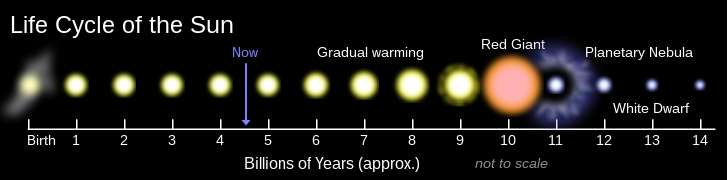
I love supernova, whether they are Type I or Type II.  I find it fascinating that a star greater than 8 times the mass of the Sun will live a very short life (in astronomical terms) and end their life by blowing up, leaving either a neutron star or a stellar black hole.  A star like our Sun, with a binary companion, after going through its red giant stage, will shed its outer layers and then the core will become a hot object, called a white dwarf, about the size of the earth. This white dwarf will cool over time. If it is like our Sun, it will be a planetary nebula for a thousand or so years until its outer layers drift off, no longer illuminated by hot white dwarf leaving only the white dwarf. The white dwarf is no longer having thermonuclear reactions, all reactions have stopped. The white dwarf is not generating heat, it it simply hot, usually having a carbon oxygen core that is very hot and takes billions of years to cool. Now if that white dwarf is a companion to another star, is close enough in orbit to steal mass from its companion, as that companion star nears the end of its life it will swell into a red giant star and the white dwarf, if it is close enough, will begin to pull mass off the red giant.  You can see this in this image and read about the process in depth from this link.


To provide an example of how big a star like our Sun is when it becomes a red giant is best seen in this image. 


Now as the white dwarf continues to steal mass from the red giant companion star, the mass of the white dwarf begins to increase.  When the white dwarf accretes and reaches a limit known as the Chandrasekhar Mass limit (1.44 solar masses which means 1.44 times the mass of the current Sun; though this is listed as 1.4 solar masses in some sources) the white dwarf begins to undergo nuclear fusion and in a matter of seconds, the remaining mass, carbon/oxygen or if the  original star is larger than our Sun, the white dwarf will be comprised of a oxygen-neon–magnesium core, collapses and the white dwarf explodes into a Type I Supernova. This link shows on PBS NOVA how this process works. 


Just to clarify, in some cases both stars in a binary system will become white dwarfs without the first one exploding as a Type I Supernova. In this case the gravity of the two white dwarfs can be drawn to each other in a dance of death, until when they merge, their mass exceeds that 1.44 solar mass limit and they explode as a Type One Supernova.  


When the white dwarf explodes, the explosion is massive. If it had a companion star, that star has some of its outer atmosphere blown off and the remaining star is sent hurtling faster than the other stars in the area of space around it, fleeing from the explosion.  There is nothing left of the white dwarf that explodes. Unlike a Type II Supernova where a massive star explodes, leaving a neutron star/pulsar or a stellar black hole. These massive stars that cause a Type II Supernova, are so large, some have an orbit out between Mars and Jupiter 
(as shown in this picture). This image shows how big Betelgeuse is compared to our Sun, the red dot in the middle and the star Deneb. Both Betelgeuse and Deneb are large enough stars that they will end their lives as supernova. 


Betelgeause from above has created and burned through most of these layers. A massive star will burn through these layers in this amount of time per layer: 

Star burns through a succession of nuclear fusion fuels:
Hydrogen burning: 10 Myr
Helium burning: 1 Myr
Carbon burning: 1000 years
Neon burning: ~10 years
Oxygen burning: ~1 year
Silicon burning: ~1 day

Then it forms Iron, and in milliseconds of the core exceeding 1.4 masses of Iron, BOOM, the Supernova explodes. A star like our Sun will burn for about 10 to 12 billion years and the Sun per above, has been burning for just over 5 billion years. 


As massive giant stars age, they produce "onion layers" (see above) of heavier and heavier elements in their interiors. However, stars will not fuse elements heavier than iron. Fusing iron doesn't release energy. It uses up energy. Thus a core of iron builds up in the centers of massive supergiants.

Eventually, the iron core reaches something called the Chandrasekhar Mass , which is about 1.4 times the mass of the Sun. When something is this massive, not even electron degeneracy pressure can hold it up.

At this point, the core collapses and two important things happen:

1. Protons and electrons are pushed together to form neutrons and neutrinos in the core.
2. Even though neutrinos don't interact easily with matter, at densities as high as they are here, they exert a tremendous outward pressure.

The outer layers fall inward when the iron core collapses. When the core stops collapsing (this happens when the neutrons start getting packed too tightly -- neutron degeneracy), the outer layers crash into the core and rebound, sending shock waves outward.
These two effects -- neutrino outburst and rebound shock wave -- cause the entire star outside the core to be blow apart in a huge explosion: a type II supernova!
Supernovae are really bright -- about 10 billion times as luminous as the Sun. Supernovae rival entire galaxies in brightness for weeks. They tend to fade over months or years.

During the supernova, a tremendous amount of energy is released. Some of that energy is used to fuse elements even heavier than iron! This is where such heavy elements like zinc and uranium come from!

The material that gets ejected into space as a result of the supernova becomes part of the interstellar medium. New stars and planets form from this interstellar medium. Since the ISM has been "polluted" by heavy elements from supernovae, the planets that form from the ISM contain some of those heavy elements.

The collapsed core is also left behind by a type II supernova explosion. If the mass of the core is less than 2 or 3 solar masses, it becomes a neutron star. If more than 2 or 3 solar masses remains, not even neutron degeneracy pressure can hold the object up, and it collapses into a black hole.

Now this is a massive explosion in either case, a Type Ia or a Type IIa.  10 billion times as luminous as the Sun means these Supernova outshine initially, for several months, the brightness of the galaxy they explode in.  If a star is really massive, like this star, VV Cephi:


when they go supernova they often have a burst of energy, released from their two poles, called a gamma ray burst. For massive stars like VV Cephi, these gamma ray bursts are long.  However there are short gamma ray bursts that occur and astronomers think they know why.

For stars that leave a neutron star, when a neutron star, which is VERY dense merges with another neutron star or with a black hole, that explosion that occurs Astronomers have long suspected that an item called a Kilonova happens. This is when a neutron star, left from a massive star after the star has gone through the supernova stage, falls into a black hole or merges with another neutron star. As shown in this NASA image:


Credit: NASA, ESA, and A. Field (STScI)

In 1 you have two neturon stars orbiting and falling into each other. In 2 they merge cause a super heated explosion with a lot of radiation. This explosion results in 3. a short gamma ray burst until the new object, probably a black hole begins to devour the remains of the two neutron stars while heating up the remaining gas that surrounds the black hole.  Eventually, the stellar black hole will not have the material around it as it devours it or spits it back out into space and it will remain unseen at that point. That is what a Kilonova is. Hard to observe as they are very short. If you want to learn more and have a better picture in your head here are some links: 

Space.com and they have a good video of the images put together showing the Kilonova. 

NASA/Hubbe Site on Kilonova discovery. 


It was the Best of Nights, It was the Worst of Nights . . .


I got out before anyone to the observing site, Pit n Pole, and took pictures of the clouds. Then I noticed something. 


If you look carefully, you can see a shadow that is being cast from a cloud from the Sun. Cool! 


Here you can see the shadow a little better. 


Here is a closeup of the shadow. 

 My 14" cooling and notice Mat's new van in the background. Especially the right side that is showing here. 

I had a different but good experience last Friday night. It was clear all day, then clouded up but my friend Mat and I headed out anyway. Good enough. We got out to our site and the clouds had parted so we began to set up. As we did we had 3 people in a car pull up and I saw a box in the car, a scope.

We introduced ourselves and then went about setting up. They had a 10" Apertura Dob with a RACI 9x50 and a Telrad. I showed Dave, the guy with the 10" how to use the Howie Glatter collimation tools that I had (he had just ordered them) and then I went back to my 14" to use the Catseye to collimate and then check using the Howie Glatter system I have.


By now we were in twilight and both my friend Mat and I aligned. As soon as we aligned, we pulled out our 10x50's bino's and started looking around for fun, to see what we could see and challenge our eyes to see. I'm really getting into including objects on my list hat challenge me, to push my eyes.  Matt gave up before me and went and got on Saturn. After showing Saturn, Mat offered to Jeremy, Dave's nephew to use his 8 inch homemade dob that he has (it's for sale!).  He thanked Mat but was hesitant. As it was dark I check out a few objects and I have some nice faint objects down in Cygnus and that was covered in clouds. In addition to be just honest, it was horrible conditions, Antoniadi IV I'd give it. However Sagittarius was up and the summer Milky Way looked good.

I then had Dave and Jeremy join me and showed them how to use a basic atlas, in this case the Sky Pocket Atlas and showed them how to hunt down objects like M22, M8, the Trifed. Mat showed them how to hunt down M51 also which was easily view able. Mat also showed Jeremy how to use the Rigel on his scope as he has that instead of a Telrad. No biggie.

From here Dave using his 10 and Jeremy using Mat's homemade 8 inch dob, went to work finding objects on their own and doing quite well. Dave suggested I show his niece who was 15 how to star hop so I did. She did really well, only needing help initially and then on one object later. We showed them the star hop to M11, and everyone nailed it and then Mat shared his nickname for it; not the Wild-Duck but the Borg Cube.

At the end of the night, Cygnus had cleared but conditions were horrible for me to go hunting so I had Dave's niece find Alberio and then I did show them the Veil and how to go to 52 Cygni to find it. They left early because Dave had to get his niece home by a reasonable hour. For the next hour both Mat and I tried observing but to no avail, conditions just wouldn't bring in the fainter objects we both needed. However, it wasn't a waste. We met three wonderful individuals and got them started we hope in the hobby. I tested 2 new eyepieces, the Baader Ortho Classic 6mm and 10mm for use with a minimal glass type of observing and to pull just a hint more of detail out of faint objects. More on that in my next post. This is what Dave posted on our local forum:

"Hi Jay, it was great to meet both you and Mat as well.
I can't tell you how much fun we all had, Jeremy told me on the way home that he HAD to have a scope of his own now but he couldn't decide whether to buy one or make one like Mat's.
Emily is a little bit shy and I was a little surprised that you got her to do some star hopping with your scope, but she loved it and was talking about it all the way home.
We will definitely try to come out again soon. My thanks to both of you"

So though I didn't have the equipment set up issues, I did have horrible skies and something horrible happen on the way home. Mule deer are quite common in Utah and a doe can weigh in on average around 150lbs. Well this night on a new highway near where we live called the Mountain View Corridor, it saves us about 20 minutes of travel time, I was in the the lead and Mat was driving behind me. I noticed Mat was way behind me and in truth had pulled over. I pulled over and just about when I was going to circle back, Mat pulled back out unto the Highway.  We turned left at a light and I noticed his front right turn signal was out so I pulled over after the turn to tell him. As I got out Mat I told him his light was out and with a sickly look on his face, Mat said "Yeah, I know."  He then showed me how a doe had nailed the right front fender, then was thrown and impacted his entire right side of his van with dents, and damage all the way down. In addition ALL the right side passenger bags deployed ripping up his upholstery and the upper lining of his van. It was just horrible.

So this observing session was not good in terms of finding personal objects, or in finding the Herschel 400 II I had down or the faint objects that I had on my list.  It was great in the sense of helping Dave, Jeremy and Emily out though.   Dickens would cover it, It was the Best of Nights, It was the Worst of Nights. I'm sure for Mat, it was the "Worst of Nights."

---------------------
"It has been said that astronomy is a humbling and character-building experience. There is perhaps no better demonstration of the folly of human conceits than this distant image of our tiny world. To me, it underscores our responsibility to deal more kindly with one another and to preserve and cherish the pale blue dot, the only home we've ever known." Carl Sagan

7/25/2013

SN 2013DY in NGC 7250

Okay, I lied. My next post is this morning, almost, and it is on the new Type Ia Supernova in the galaxy NGC 7250.  If you know a lot about Supernova, you may want to pass on this entry. If you want to look at the blown up images to see identify the area the white dwarf(s) that went supernova originated from, look at the images. Be warn, I do have a humanitarian message at the end. Bottom line, you can view this SN right now and if you have a telescope of 8 inches or more, maybe 6 inches and a good dark site, go for it and view this bright new Supernova. It should be reaching peak soon and then will begin to fade.  You can look at images by wonderful amateurs who have imaged the galaxy and SN 2013DY at this link at Bright Supernova.

The color images are coming from Professor Courtney Seligman's site at this link.  From that site we learn that NGC 7250 is a starburst galaxy which I guessed when I saw it, and that it is about 55 million light years from us.  Just think, if that is true when this white dwarf actually blew itself up the Earth was entering the Paleocene–Eocene Thermal Maximum where the Earth in a heated up over 11 degrees F or 6 degrees C and caused the extinction of around 45 to 50% of all species on Earth, including a lot of ocean animals. Mammals did fine through this though.  Look it up for more information, it is rather interesting.  Anyway, we also know that this site that the galaxy is about 25 thousand light years across. The professor also states from the site,

"In the closeup below, NGC 7250 is the galaxy at the center. The group of three bright blue knots above center is listed as a quarter arcmin wide galaxy (PGC 214816) in LEDA, but I can't find any other reference to such a galaxy, and the knots look more like a part of NGC 7250 than anything else."

Head on over in the link if you want to learn about NGC 7250.  I would agree to me, the knots look to be part of NGC 7250 and possibly part of new star formation areas, but I'm not a pro so I am probably totally wrong on that. Right now SN 2013DY is about mag. 12.6 to 13.0 (I vote for the mag. 12.6 or so) and that puts in the range of amateur telescopes. NGC 7250 is found in the constellation of Lacerta which is visible at this time.

Below I have two sets of images of the NGC 7250, the black and white I used JING to capture an image from Stan Howerton's excellent image over at Bright Supernova.  I did this so you can compare the before and current images. In truth, and it is far beyond the possibilities of any survey I have access to but I was seeing if it was possible to see the general area where the progenitor originated in any images. Yep, it is. Can I see the actual binary pair? Nope, and I knew that. The best I can do is to capture the general area.  Just something fun I want to do with brighter supernova is I think to try and go after and see if I can find the progenitor star or white dwarf's general area.  Maybe one day I'll get lucky and we'll have another Supernova in M31 (been over a 100 years now) and I can try to identify the progenitor there. Probably will never happen but I can at least get the general area.  Anyway you can see in the top color image the two stars or clumps above the brighter and bigger ones across and slightly up from the writing and arrow.  Things are far too tine to see where a progenitor may be. However, in Mr. Howerton's image you can clearly see how bright SN 2013DY is and that it is located slightly down from the two white stars that look like doubles, and slightly across and up from the two blue stars that are positioned going from the left corner to the right corner. So location is identifiable.


Here I really blew up some images to show those two diagonal stars going from bottom left to upper right . If I go to the bottom blue one, that make up the three by themselves, and slightly across to the left and slightly up, I see nothing. Do I think the progenitor white dwarf is there? Yep, somewhere. Since this is a Type Ia SN, that means a white dwarf (and we won't see it from this distance with amateur telescopes, anyway, the white dwarf stole enough mass from its binary companion as the companion began its final journey and become a Red Giant, and the white dwarf's mass eventually went over the Chandrasekhar limit of 1.40 (I've seen it as 1.38, 1.40 and 1.44 so I am going with the 1.40 which is in the middle) and blew itself up in a runaway thermonuclear reaction.  The other way is that two stars each over their lives spent time on the main sequence, were less than 6 solar masses or so and became Red Giants and then both eventually settled as white dwarfs. I would assume and that is dangerous that as one was a white dwarf and the other going through the Red Gian phase, that as mass was accumulated, it eventually was blown off from the white dwarf in what astronomers call a nova. Thus the white dwarf never accumulated enough mass to go over the Chandrasekhar limit and never became a Type Ia Supernova. Eventually the companion did become a white dwarf also, and that meant we had two white dwarfs orbiting each other. Well, their mass attracted themselves to each other, and much like a couple in love who should never hook up but do, when the two white dwarfs embrace in their deathly dance and kiss, becoming one, the Chandrasekhar limit is surpassed, and BOOM, a Type Ia Supernova occurs. 

So in SN 2013df we have a Type Ia Supernova (the spectra that astronomers take tells them what tpe of Supernova they have.  You can make your own at Cool Cosmos at this link, and you can see what a spectrum is. The colors tell you what elements are present. If you make one,  NEVER USE IT TO LOOK AT THE SUN!!!!!!!!!). Anyway if you compare the two pictures you can get a general feeling where the progenitor came from, its location and then you should see something else. You should see HOW MASSIVE these Supernova area!!!!!  They are shinning brighter than the galaxy in the sky.  If you turn your telescope to it, you'll see it if you have a big enough scope and you'll see the fainter galaxy.  I'll do this I hope next week one night.  But look at how bright and big SN 2013dy is! Incredible. 


So what is the purpose of all this? To see something, know its general area where the progenitor came from, understand part of the process, and realize how powerful these things are. Equally important, these supernova seed the surrounding area in space with heavy metals that are used to make new stars/suns, new solar system and I would hope, somewhere, new life. The iron in our blood, the calcium in our bones and the heavy elements we use in our daily lives all came from a Supernova and these elements, created the Sun which is our star, the solar system our pale blue dot is located in, and that very pale blue dot we all live on.  These elements were used to create life on this planet.  So, next time you hear about a Supernova, remember in its final act of dying, in its death, the star, gives back and creates.  In a way, the star is giving of itself back to the universe so new things can come from it. May we be like a supernova and look to give back to others by being kind, caring and helpful to each other.

7/24/2013

Observing July 9th and 10th, 2013 Pit n Pole Utah; Land for Observing II; Protostar Secondary

July 9th was according to the forecast. due to be a wonderful evening with outstanding transparency and very good seeing. Every weather web link I could check, Clear Sky Clock, Skippy Sky Astronomy, Underground.com, Intellicast, National Weather Service Salt Lake City, COD Meteorology and Nighttime Observatory all agreed. So my hope was this was going to be one of those nights of nights. We had decided on Pit n Pole for its closeness, 45 minutes and the ability to get back home after observing. I arrived after my friend Alan and he was in the process of setting up. On my drive out I noticed something I really didn't like. There was a strong band of lower level haze, and as I drove out to the site in the west desert, it was easy to tell that this was smoke from a fire. It was in reality, smoke that blowing northward with winds from a major forest fire in Las Vegas. Well, that was hard to predict and having only recently returned from California on a matter of family business, I wasn't as aware as I usually am about events that could impact seeing.

As I turned onto the Faust/Pony Express road I knew that the conversion to a gravel road had begun from a drive out to my property the week before. You can see the shots of the gravel road here and the new speed limit.


These are the pictures I took the week before when I was in my Altima. I didn't push it because I didn't want gravel to fly up and damage the paint. In the Pathfinder this day I took it up and was easy doing around 45 to 50 with no problems.  Enough vehicles had driven on the road that in each direction there were two sets of tracks that had worn the gravel away and allowed one to travel at a good clip. I stuck around 45 and was comfortable.  That is better than the old road where there are still pot holes and you have to basically stop to go through those areas. I would rather have a constant speed than to speed up and slow down, especially with a scope, eyepieces and other equipment that I don't want bumping all around. I thought this would be a bad move, so far I am finding it is not as bad as I thought. I reserve final judgement for when I go out for a couple days of observing at the Forest Road sites in a couple of weeks if the weather holds up.


The Faust/Pony Express Road is paved for just over a mile on the turnoff from SR 36 by Five Mile Pass and for just over a mile after the Rail Road Tracks you cross to go down into Faust.  Here is the new gravel down by Faust.


Here is the main road going into my land that I own southwest of Vernon.  It leads also to the neighbor's land and home which you may see in the distance.


This is the visual field I was going to use and have step up in a few times.  SQM here is 21.47. The Forest Road is usually around 21.88 to 21.90, except when the summer Milky Way is up and that drops it by around 15 or so points to around 21.77 (my land would drop also). So this site is equal to the Pit n Pole site in terms of darkness with no lights impacting.


This is what has got me looking to sell this property off in lots like the neighbor here has done. He has 3 lots sold, one looks to be building already and I never want to compete with this many neighbors on a remote site. So I have an agent and the listing(s) are up as I write this. I'll sell for a profit the entire plot or I'll see in individual plots which I would prefer as I make more on the individual plots.


However, all is not lost. I am looking for land in southern Utah now, as I want something down there we can retreat too or perhaps retire too, or if we retire to southern Utah, have some land I can go escape to!
On SR 36 as you go past Vernon and over the hill and past the railroad tracks there are 40 acres for sale as you can see here. Up to the ridge and over to the other side.  It's fenced and right next to BLM and Forest Land so selling of land though other things I am sure can happen.


Here is the road on that takes you up to the ridge. If I offer and it is accepted then I'd have this graded and new gravel put down like I did on the other.  


 This is the view looking east from the other side of the ride. You have the same view to the north, and the Vernon Hills and other hills block the Depot's lights so if the prison goes out that way, it should be blocked minus any sky glow it puts out.  The road you see here is a BLM road leading to a Forest site up in those mountains to the east. There is another nice observing area up there as well but you into more LP from the Provo to Spanish Fork Light Dome. I love the wide open vastness of the site and there is a point on the other side where you could set up on the land and have an open view 360 degrees like Pit n Pole, but much darker (I was out there and got a SQM of 21.88, 21.91 and 21.89.  No dry lakebed there either for humidity.


Here is the sign showing the land here for sale. I need to have my agent look into this this week.  My goal again is to eventually create a dark site where amateurs can come with their visual scopes or to a nearby spot their astro-photography and setup and enjoy an evening without being bothered.  The part of the land would be open and I'd put a combo lock on the gate like SLAS has done at SPOC and if you request the combo from me, or my good friend who will have it, and we approve, then you get the combo and can go out  as long as the rules for the site are followed (clean up all trash, use the facilities on site if you have to go, camp in the required area.  I had been thinking of putting a bunk house and stuff but I think instead I'll make sure there is a power source for those who do Astro Photography and then a camping site for those who want to stay the night and they can camp. I'll put a Yurt or something for me and my family to use when we are there, and perhaps a close friend or two in the winter.  Scaling down is the right thing that way the land is there to be used, I keep a good camping area, perhaps put in some poles and have available some tarps in a shed for those who want to put them up for shade in the summer where they camp.  Bottom line though, I've decided to keep it basic.

So, enough of that. I got out to Pit n Pole and it did NOT look good. I thought I had wasted a drive out and the effort to load. Alan was setting up but I waited as I had arrived really early like Alan.  I waited and finally, a breeze came up and slowly the smoke began to lift. As conditions were improving I decided to set up. I had to a complete re-collimation as I had installed with Mat a new Protostar Secondary.

PROTOSTAR REVIEW

Now I know some of have had problems with communication with Bryan. I had ordered and so had my friend Jeff and there was no communication, nothing. Well, I emailed Bryan expressing my displeasure on the lack of customer service and communication, and saying I would be happy to blog about my experience here.  Well, Bryan got back to me in a few days, he had been at a conference or out state on business for his real job. He graciously apologized and let me know what was happening. My friend Jeff got an email the next day and his order was fulfilled.  I admit, I felt bad or having to be firm, it may seem weird to those who know me, but I can be firm when needed, but I much prefer to find a win-win solution. I have to say that Bryan made this a win-win solution and I now have one of his fine secondary mirrors installed. Once the communication issue was solved, which is all I wanted, I just didn't want to be out the money as I pay the credit card off each month, but once we communicated everything went great! So I know Bryan is a small business and he does this on the side, and my only recommendation is to communicate. I think that is all any consumer wants. I have ideas on how to do that but I'll keep them to myself as its not my business and I don't see a need to do that here.  Overall though,  I would have rated my experience up to the communications a 1/10 and now I would put that as a 8/10, just because of the hiccup in communications.

Back now to observing. I got collimated and got everything set up as Mat had arrived and was doing the same thing. Mat aligned before me as I watch the skies improve and the sun set in a brilliant red from the smoke.  I then aligned and waited. As Antares came out Mat did a Star Test, which I also did and did a minor adjustment and then went to Saturn for a quick look.  After viewing Saturn, I went and pulled out my observing list, self generated charts and planned out my night.  At the beginning after Astronomical Twilight ended, I decided to look at some eye candy including M4, and some old PN's in Cygnus.  After that I put the OIII filter on the Panoptic 27mm and the ES 30mm 82 degree and checked out the Veil, both the western and eastern portions. Conditions had improved from what I would have called an Antoniadi V when I got there, to a IV and now they were at a III. Not great, but decent, good.  After looking at the Veil it was time to chase after Sharpless 2-091.  Here is a finder chart from ReinerVogel that shows where this is located: LINK.  I've made one from Starry Night Pro that your welcome to use. It is on my Google Docs at this link.  Realize my chart is roughly drawn in and shows the general area with a lot more stars.  I used this chart, Reiner's chart and a couple of images of the SNR and felt I could see with the OIII filter with the Panoptic 27mm thin filiments above HD185735 and above TCY2150-1413-1.  Mat did not see anything and seeing and transparency were not good so my goal is to retry this observation come my next new moon outing with what I hope are better skies and darker skies. Still, I should have been able to pick it up and personally, I felt I did pick up the faint threads of this SNR but I'll try again before calling it observed. I spent a good hour and half hunt down 091 and 094 before moving on.

Next I went back to the Herschel 400 II list and worked some PN's.  Here they are.


 1. NGC 6772 Planetary Nebula in Aquila.  July 10th, 2012, 1:19a..m. MDT; Antoniadi III; Pit n Pole, Utah; 14" Dob; 14mm & 10mm Pentax XW, OIII Filter; Type 1 Paracorr; Mild and hazy.

For some reason the sunlight coming through the window when I took these pictures dimmed them. So realize the actual PN's are brighter on the sketches.  This is a rather bright PN, gray in color, roundish in shape.  It is brighter on the edge and darker in the middle, but the middle is all nebulosity.  No central star is visible.


2. NGC 6804 Planetary Nebula in Aquila; July 10th, 2013; Pit n Pole, Utah; Antoniadi III; 14" Dob; 14mm & 10mm Pentax XW, OIII Filter; Paracorr Type 1; Mild and hazy.

This is a bright PN that jumps out with the OIII filter. The OIII filter is better with this object than the Orion Ultrablock.  Mag. 13.5 to 14 central star is visable with non-filter view.  Filter seems to hide the central star. Round in shape in the 14mm and the 14mm did not show the central star, only the 10mm Pentax XW did.  No color other than gray.


3. PK 36-6.1 PN in Aquila;  July 10th, 2013; 12:39a.m. MDT; Pit n Pole Utah; Antoniadi III, mild and haze clearing; 14" Dob; 20mm Pentax XW Finder; 10mm Pentax XW to observe & sketch; OIII Filter; Paracorr Type I;
Notes: Central star is easily seen at 165x. Shape is roundish to semi box like as you increase magnification.  The NW is the brightest part of the planetary nebula, and mottling is evident in the PN.  West is to the bottom left corner. 


4. NGC 6548 a Galaxy in Hercules;  July 9th, 2013, Pit n Pole, Utah; 10:45p.m. MDT; Antoniadi IV to a III, haze below 20 degrees due to fire from Las Vegas; 14" Dob, 14mm Pentax XW with Type 1 Paracorr.
Notes: Galaxy has a diffused outer shell, with bright inner core region.  Perhaps a stellar nucleus with averted vision.  Conditions at this time are not great but they are improving resulting in poor transparency making this a difficult object to observe and sketch. I will re-observe in August.


I then tried some more galaxies that evening in Hercules but I need better conditions to get the detail I want out of them.  That night wasn't a waste, no night under the stars is and I captures a few more Herschel 400 II that I just did not want to sketch. I'll add the objects to this entry this weekend after I pull out my list.  

Next is a practice sketch I did since I couldn't use my Explore Scientific AR102 during the moon phases this month due to the summer monsoon and the clouds and rains it is bringing.  So here is my practice sketch of Cedarbald 124, an emission nebula in Cepheus.  I have two different shots I took so I'll post them both.  It's lighting conditions, I need to find a better place to photograph these. I did these as I am going to use the refractor to hopefully do some wide field sketches this summer before the great summer objects fade away and I get back to teaching.  


In my next entry this weekend I will review my Explore Scientific AR102, the Twilight I mount, and a book on Supernova hunting I just finished. Here is a sneak preview of the cover of the book. It is Supernovae and How to Observe Them by Martin Mobberley.  I enjoyed it, have a couple of minor quibs but I'll cover that in my next entry.  Then after that, a couple of more books, hopefully a couple more observing sessions and reviews of some other goodies I have acquired or will be acquiring soon. Clear dark skies to you! 


7/08/2013

Catch Up!!!!

Wow!!! Where does the time go?  I find at 48 I am reflecting more and more on my life, where I am at, what I have done, and where I am heading.  This last year has been horrible for astronomy though I did get out April 1st, April 6th and May 10th & 11th 2013.  I'll post some of my sketches of those nights in a minute.  First, some orders of business.  I received an email from someone a woman named Brittany who shared with  me, and has shared on various astronomy sites on the web, some videos she made/compiles as tributes to Carl Sagan using the world renown violinist Daniel Hope's music from spheres.  Here is a link to one over at YouTube that I just think is amazing. It is comprised of the quotes of Carl Saga.  Here are some of the quotes I enjoyed, and I like almost all of Carl's quotes (not all, but almost all):

"For small creatures such as we . . . the vastness is only bearable through love."

"You feel so lost, so cut off, so alone, only you're not. See, in all our searching, the only thing we've found that makes the emptiness bearable, is each other.”

"Science is not only compatible with spirituality . . . it is a profound source of spirituality."

“Every aspect of Nature reveals a deep mystery and touches our sense of wonder and awe."

and last:

"The visions we offer our children, shape the future."

If you enjoyed that here are the links to her other two videos on YouTube. Link 1: Inspiration from Carl Sagan:  Link 2: The Pale Blue Dot.  I love Carl Sagan's talk on the Pale Blue Dot.  I don't think it has been equaled.

Alright now. Back on topic here. I am going to post my observations from April, May and June here. I'll talk a little bit about them.  In April I got out on the 6th of April to do some observing. April was an interesting outing as I spent time once again working with my scope and after working out the kinks, I found I had plenty of time but I was exhausted. Funny how work can get to you.  I had a very difficult class this year and I felt exhausted in April from having to manage them all year.  So this night I felt it, so I did a lot of eye candy stuff, I did about 8 Herschel 400 II's with only a few sketches and that was it.  Here are the sketches from April:

IC 2574 a Dwarf Galaxy in Ursa Major
April 6th, 2013
Rush Valley, Utah
Antoiadi II
Clear skies, some clouds to the far north
14" Dobstuff/Zambuto Mirror
27mm Panoptic used as a finder eyepiece for the field;
10mm Pentax XW to sketch/observe
Size: 12'x4'
SQM 21.64
Notes:
This galaxy has a very ghost like appearance with a very low surface brightness.  star are imposed to the edge.  There are two bright parts easily seen, a bright nucleus and a bright HII region.  Looks like two cores when observing.  Te two brighter parts were easily seen.  Very fun galaxy to pursue and observe and yes, I did go over the galaxy the first two times I attempted to located it.  Good one to try when your at Messier 81 and 82 if you like fainter and challenging objects.


That was my big win that night and I was excited about capturing it.

My next night out under the stars was May 11th, and this was a pretty good night. I captured 16 objects that night and sketched the following.

1. NGC 3190 and 3193 Galaxies in Leo, just under Adhafera
Location: Five Mile Pass, UT
SQM: 21.53
Antoniadi III
14" Dobstuff
27mm Panoptic
Notes: Three galaxies in view, one is dim but NGC 3190 & 3193 are evident in the field of view. Bright inner cores.


 2. NGC 3626 SO Galaxy in Leo
May 10th, 2013
11:38p.m. MDT
Antoniadi III
14" Dobstuff
10mm Pentax XW
FR006 Site High Up
Notes: Has a bright stellar core, bright nucleus, the outer portion is dim and I believe I detect a hint of structure to it in the arms.


3. NGC 3599 & 3605, Spiral Galaxies in the constellation of Leo
May 11th 2013
12:13a.m. MDT
Antoniadi II
14" Dobstuff
27mm Panoptic as finder
10mm Pentax XW observing/sketching
Notes:
The top galaxy is extremely bright with a bright stellar nucleus and a bright inner core region.  Diffuion surround the core with no structure seen.
The bottom galaxy is small, also has a bright core region and outer diffusion with no structure.
A third galaxy faint is visible on top. It is very faint and just diffused with no core evident.


4. NGC 3611 Spiral Galaxy in Leo
May 11th, 2013
FR 006 Up High
01:00a.m. MDT
Antoniadi III
Mag. 9.2
14" Dobstuff
10mm Pentax XW
Notes:
Small bright galaxy with a bright core and no nucleus is observed.  Diffusion surrounds the core.  Somewhat round/elongated to the SW.


My next outing was on June 1st, 2013 to a place we go to now called Five Mile Pass. We are avoiding the Pit n Pole location during fall, winter and spring because of the dew issues there. I will be there during the summer though when dew is not an issue.  So on this night I had invited a friend to come out who was having some frustrations with his scope and on finding things.  Dion came out and I spent most of that evening helping him to find objects. Now I am going to post something that I have always felt is the key to getting people to try the hobby and stay with it.  The key is to teach them how to find items using their equipment. So I had an extra copy of the Sky Pocket Atlas and Dion and I would use it on my 14 inch dob to find items, me scaffolding or supporting Dion and showing him the star hop, having him do it on my scope and then go back and do it on his. My friend Mat helped Dion to collimate his scope and to work it so between us, Dion got set!  By the end of the night Dion was a pro at finding things. He took some awesome pictures and he has shared them on our local board, Utah Astronomy but I will share them here, and then the two sketches I did that night.

I want to mention that here that I no longer do a bunch of outreach. I have too much to do and yes, I am very selfish on the time I get to observe. It is limited as I have other things that also demand my time. However, the outreach I LOVE and will set aside whatever my plans are is to do what I did this night, teach people how to use their equipment to find items. If they leave doing that, then they are caught! Perhaps when I am older outreach will have more of an appeal to me but right now, the outreach where you simply have people and kids come by, look in the eyepiece just doesn't appeal to me. However, if you want or need help learning to star hop and use your equipment in the field at a dark site, come along with me when I go observing and I'll teach all night and enjoy it all night! The offer is good on two conditions. One I have to kinda of have to know you and you have to live and go where I observe or come visiting out here.

So I have to thank Dion for all of his time away from his family that allowed me the honor to have helped him perhaps just a little bit.  Here are his pictures.

Here is my 14 inch Dobstuff Strut Dob with a 14" Zambuto mirror and a protostar secondary. I love this scope!


Here is Mat's 16 inch dob that he made from scratch. He ground the mirror, and built the structure. He'll sell it if your interested and it gives great views! 


Here we are collimating our scopes. 


Five Mile Pass is not our main dark site but it is only 40 minutes from home so it is convienent.  Here is the rising summer Milky Way with some light pollution on the horizon from the Provo to Spanish Fork area.  SQM averages around 21.5 to 21.55 around here. 


That night as we were observing I looked towards Tooele and saw what looked like several zodiacal lights which we see every time we are in the desert in the winter and spring.  Anyway there was some green tint to it and when Dion took this shot it explained what I had seen, the Aurora Borealis. 


Now as the night wore on, Dion was good to go, I hope and I managed to get a couple of objects and quick sketches in.  Here they are: 

1. NGC4235 Spiral Galaxy in Virgo 
June 1st, 2013 
1:46a.m. MDT 
Antoniadi III 
14" Dobstuff 
10mm Pentax XW
Five Mile Pass UT
Notes: 
Wonderful galaxy face on.  Hint of an arm from the south to the west.  Right inner core region. Hint of a stellar nucleus with averted vision. 


2. NGC 4233 & NGC 4224 Galaxies in Virgo
June 1st, 2013
1:05a.m. MDT
14" Dobstuff
20mm & 14mm Pentax XW w/Paracorr
Antoniadi III
Five Mile Pass Utah
Clear, very cool no clouds.
Notes:
Two galaxies that are close together, one in the NE corner which has a bright inner core region with strong diffusion surrounding the core. Averted vision is needed to see the galaxies shape.  The galaxy in the SW took averted vision to hold. It is very faint with a low surface brightness.  Nice field.


June 8th to June 9th 2013 at Pit n Pole Location 

This night I went to the Pit n Pole and was joined by my good friends Mat and Jorge.  Jeff had a prior commitment if I remember right.  It was a GREAT night, the best of the year and the BEST since getting my telescope last fall.  Tonight everything was working perfectly, including the most important part, the operator!  One of the most productive nights I've had. So here are the sketches though I bad about 8 more H400 II that I did not think worth sketching. 


1. This is a sketch I did and I forgot to label which galaxy it is. I will have to re-search and edit this post, I now it is SE of NGC 4261. 


2. NGC 4260 Galaxy in Virgo
June 8th 2013
Pit n Pole, Utah
10:50 p.m. MDT
Antoniadi II
14" dob
10mm Pentax XW
Notes:  Diffused outer portion, making this galaxy look edge on perhaps or tilted.  Bright inner core with a stellar nucleus that shows with both direct and averted vision.  Nice view.


3. NGC 4266 elliptical galaxy in Virgo
SE of NGC 4261
June 8th, 2013
11:08 pm MDT
14" Dob
10mm Pentax XW
Antoniadi II
Notes: Nice and bright, elongated NW to SE wtih some structure evident.  Bright inner core region.


4. NGC 4261  Galaxy in Virgo
June 8th 2013
11:35pm MDT
Antoniadi II
14" Dobstuff
10mm Pentax XW
Notes: This is a large elliptical galaxy with a bright core and a stellar nucleus that is easy to see. One\portion of the galaxy is brighter from the SE wrapping to the NW.  Made it look somewhat like a spiral but it isn't, just brighter on that side.  Very nice image. This elliptical galaxy has a 400 million mass black hole that is active and feeding right now, spewing out 88 thousand light year jet. There is a very faint companion NGC 4262 that is easily seen below it.  Bright tine core, pinpoint with a stellar nucleus with averted vision.


5.  NGC 4281, 4270, 4271 4277, 4168 Galaxies in Virgo; most are elliptical.
June 9th, 2013
12:09 MDT
14" Dobstuff
10mm Pentax XW
Antoniadi II
Pit n Pole, Rush Valley, UT
Clear and Mild
The sketch below was the first rough draft I did to identify the field. The second sketch is the one I took my time one.
NGC 4281 is the galaxy on the bottom or eastern side.  It is a large bright galaxy with a bright core region and a stellar nucleus, laying east to west.
NGC 4273 is up and to the left.  It is the 2nd brightest galaxy in the group with a bright core region.  Next to it and to the east is
NGC 4273 a small galaxy easily viewed.
NGC 4268 is the narrow galaxy above or to the north of NGC 4273.
NGC4770 is on the western edge.  It has a bright core with a stellar nucleus.


Similar to the one above, done at the eyepiece without the labels.


6. NGC 5480 and 5481 galaxies in Bootes
June 9th, 2013
12;50a.m. MDT
Antoniadi II
14" Dobstuff
10mm Pentax XW
Pit n Pole UT
Clear, Mild
Notes: NGC 5480 is bright, with an even surface brightnes and a hint of brightness near the core at times.
NGC 5481 is larger than NGC 5480, has good brightening near the core region with a stellar nucleus evident with averted vision. Nice pairing.


Well, that's all of the sketches. I felt so out of sketching shape that I can't wait to get out the next several days here to do some serious sketching.  I have a lot of reports to enter for the blog for the following items:  

SQM-L  Review 
20mm Pentax XW Review 
Explore Scientific AR104mm Refractor with their mount I got with it.  
Contrast Filter to go with the Refractor 
Four new books on Astronomy  

So during new moon look to those coming. It feels good to be back on the blog.  See you in a few days after observing in the hot west desert of Utah with mild temps. no bugs and a wide open sky with mag. 7 skies!  I can't wait.  Anyone want to join me?