Pages

8/28/2011

Next Weekend, The Wedge and Wolf Creek


EDIT: Due to some personal items I am NOT going to the Wedge this weekend (in September). Instead I am going to Pit n Pole on night and Wolf Creek on the other (learning towards Wolf Creek on Saturday though not sure). Same deal applies if you want to try using my 10 inch scope.

Jay

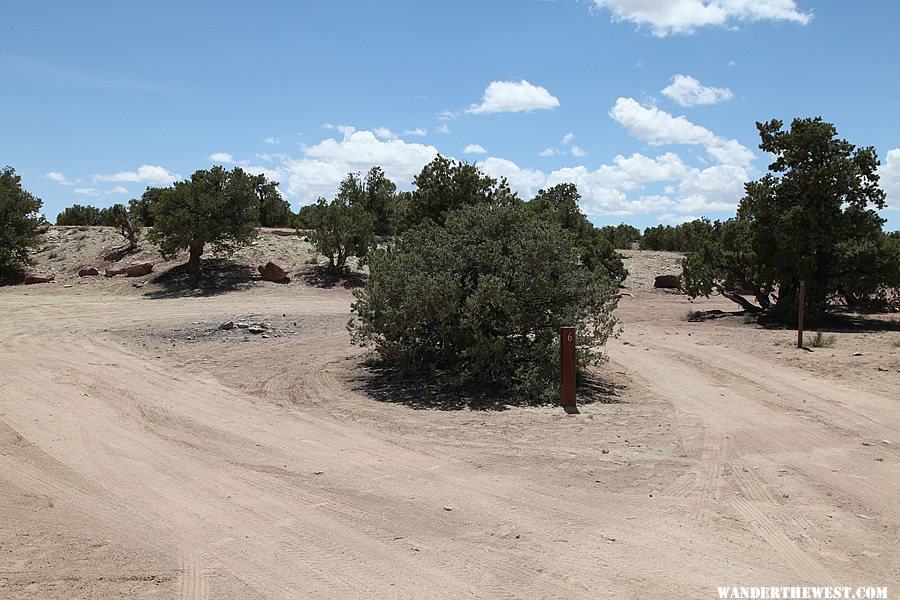
Here is an image of campsite 6 at The Wedge here in Utah. Campsite 8 is the site my friend Joe Bauman uses to observe from. Next weekend I hope with a few friends to observe from here. I posted about The Wedge last January in this post and now it has become time for me to go and test it out. Next Friday, my friend Mat and I as of now and with the weather permitting are going to head there and use the site for visual observing. It's about a 3.5 hour trip from Salt Lake City and besides the outstanding night sky, in the morning you can see one of Utah's wonders, The Little Grand Canyon before heading home (see my earlier post). We won't be leaving til mid afternoon on Friday so if your interested, leave a comment.

I am still planning on next Saturday at Wolf Creek also. It will make for some long drives but I like driving but if you want to hitch a ride, I have room for one other person in my Pathfinder. Also, if you want to use my 10 inch scope at Wolf Creek please let me know. As of right now the forecast is looking really good for next weekend so here's to a wonderful weekend of observing. The downsize for me. I need to come up with a new observing list. I only have the spring Herschel 400 left and they are not visible at this time of the year. So on to my next set of objects!

Stars on long exposure at The Wedge


Now we do not observe near the Little Grand Canyon, the site is a mile or two from the location but here is a wonderful link to a video on YouTube to show you the Little Grand Caynon.

8/27/2011

Clear Dark Skies?


I have ran into several people who are amateurs from back east who think I am so lucky to live in the west, especially in Utah. I will openly admit that we have some wonderful dark skies in Utah when compared to most parts of the country, but we still have our challenges. Also, dark skies come in many forms so be careful what you wish for , you may get just that. I was hoping for dark skies this weekend, and I think I found them . . .

One of the challenges we face in Utah is this thing called the monsoon, and this year, well, its been in the way more often than not. The monsoon this year started early in June and has never really let up this year. Maybe for a week here or there, especially around full moon, but its been a struggle all summer. The cause of this is a high pressure that parks over the four corners (where Utah, New Mexico, Arizona and Colorado meet) and that rotates moisture up from Mexico on the back side into Utah. It is the pits for observing especially around new moon. Last night wasn't any different. I wanted to go to Wolf Creek but that is out of the question because I'd be sitting in clouds I fear at 10,000 feet. So my friend Mat and I decided to try Pit n Pole since it is only a 45 minute drive for us and if we got skunked by clouds, it's not a bad drive and its quick. I got out there first and though hoping it might clear after the setting of the sun, I lost hope pretty quick. But it wasn't a total lost. On the way out I saw my friend the buck antelope and it was nice in a way to know he is in the area I guess. Click on the pictures as always to make the image larger.


After making my left turn off the bumpy road (it needs some TLC out there but state funds are really low so I guess back roads aren't a priority in Utah) I noticed a rather large rainstorm hitting the area to the south. It was captivating in many ways so I took the camera back out and started taking pictures. Here are some of what I captured:


Looking to the Southwest, dark skies but not the kind I want . . .


Yes, that is sheets of rain falling down, rather cool I think! Oh, I wish I could share with the smell of the rain out in the desert and the smell of the sagebrush (yes, it can cause allergies to go off), and the feeling of the expansiveness of the view. I think I connected this day with what I call my inner John Muir, it perhaps like a religious experience being part of this and being the only human (minus the one car on the highway that drove by at one point) that took this in.


I am hoping between the two images you can get a feeling for how fast this storm was moving. I took them back to back with about 10 seconds between shots.


Here's that same cell moving east and about spent.


Here's the view right after the turn on the dirt road looking northwest. At the low point was a really good down pour also.


Still some showers to the west south-west here.


Looking south-south-east with more rain showers in the distance. Yep, more dark skies!


At the Pit n Pole location (where we setup) looking east to the Wasatch Mountains (Mount Timpanogos in the background). Yes, blue sky! Not for long though.


This picture is at the Pit n Pole location looking north and it isn't looking so good out there.


Well, that's all I post on the blog (I have more). I did have a wonderful time listening to Mat (he showed up right after these pictures were taken) and he told me about his adventures in Bryce Canyon at the ALCON that was there and being out at Great Basin. I am going to go to Great Basin as everyone who has been to both just raves on how dark Great Basin is over Bryce now. We also discussed some of the counter weight issues for when I get my 14 inch Zambuto mirror and how to counter the loss of weight. We went in the ATM projects I am going to do and I am going to do the dew straps since fall is coming up and that can be problem. Then I'll work on the 8 inch mirror and building that into a scope and I have my new chair that I am going to do and finally a binocular rig that will hold my binoculars in place so I can sit back and observe without holding them. Probably done in that order. I really enjoyed talking with Mat as we hoped for the sky to clear and between a great conversation with a good friend, my inner John Muir moment and the pictures, I really had an enjoyable experience. Just wish I had been able to get some observing in, only thing missing. Oh yes, I learned a new motto as well. I want CLEAR dark skies, not just dark skies since they can come in many facets as I showed today . . . So here is hoping you have clear, dark skies.


8/22/2011

PK38-25.1: A Planetary Nebula in Cetus


PK38-25.1 with a background galaxy.

I subscribe in email to a wonderful service really designed by graduate students for undergraduate students. Many of the articles they post are really interesting and I love following Astrobites. Today, in this article, they discuss planetary nebula and specifically a study done on Abell 70 a very interesting planetary nebula that is a binary system and as a side note it has a background galaxy at the top of it. You can see this at this APOD image here. What is fascinating is that in this system the central stars are a solar-temperature main sequence or subgiant star (G8IV-V) and a hot white dwarf (WD) companion. The white dwarf is really faint and was identified not by optical spectroscopy, but by UV imaging (see the article please).

This planetary nebula is in the constellation of Aquila and is primed for both visual observing and astro-photographic. It has a visual magnitude of 14.3 so in the right size scope, but it is challenging because of the star field and neither a OIII or Ultrablock filer helps much here. Here are some links about viewing these:

Jay McNeil Data found here.

:Update: December 22nd, 2013 (16 months after the original post): At the request of the original poster of the observation who left me a comment tonight saying I didn't not credit him in the tabular data, though  I did post a link back to his page which gives him the credit, (see this link where it discusses how a link is a bibliography and shows the author of a blog is not claiming the original work as their own while directing traffic back to the original author. It states: "it’s also polite to link back to the author’s original work. This makes it clear that you’re not claiming that you created it yourself, while also helping to broaden the audience for the original poster. Linking is the virtual equivalent of a bibliography – it gives credit to the work of the original authors and helps to build the blogging community by creating connections between writers.").  I have decided thought to remove the table of his observation and the link and not drive traffic to his observation. Evidently that observer does not want their information posted or linked to their site on another site or blog. No offense was intended and as stated, the original was linked back to the observer's own web site to give the author both credit and to drive traffic to their website.. The data is removed and if I find I did that to any of his other observations, I will remove them.

I'll offer a richer replacement though with a link to the Deep Sky Forum Object of the Week for September 9th, 2012 which has several different recorded views of this PN and Galaxy. Someone going to observe this object will find a more complete set of information there I believe anyway.


So if your in for a challenge this summer and like planetary nebula then this can be a good challenge object for you. I am going to try for it this weekend and will hopefully have a succesful hunt. Here are some finder charts from Starry Night Pro to help. It is just above the Saturn Nebula (another great planetary nebula to view) and Messier 72 & Messier 73. Click on the image to make it larger. The star hops are from Al Bali, the end star in Aquarius. Good luck!


8/21/2011

Changes to the Orion XX14i Mirror and Mirror Cell

Well, I have a friend and observing companion who recently ordered an Orion XX14i from Orion with the notion of updating the mirror from Carl Zambuto. To make a long story short, Orion has taken the convex mirror and updated mirror cell from the XX14g model and put that into the XX14i model. It should save weight and make cooling time quicker, allows for up to 3 fans to be installed to cool the mirror and thus is a good thing unless you want to upgrade the mirror. That becomes more difficult than if you have an older Orion XX14i with the regular mirror and 18 point mirror cell as seen in this article by scrolling down or see the image below.

Here is what Orion has on their site about the XX14g and their mirror. I would assume they would be updating their website on the XX14i to include a similar statement:

"The XX14g features an innovative convex-back 356mm diameter primary mirror and a newly engineered mirror cell, which weighs 10 lbs. less than standard 14" mirror and cell combinations, yielding faster ambient temperature equilibration times so you get optimal visual results more quickly. The mirror cell accepts six specially designed threaded counterweights (included) to optimize balance."

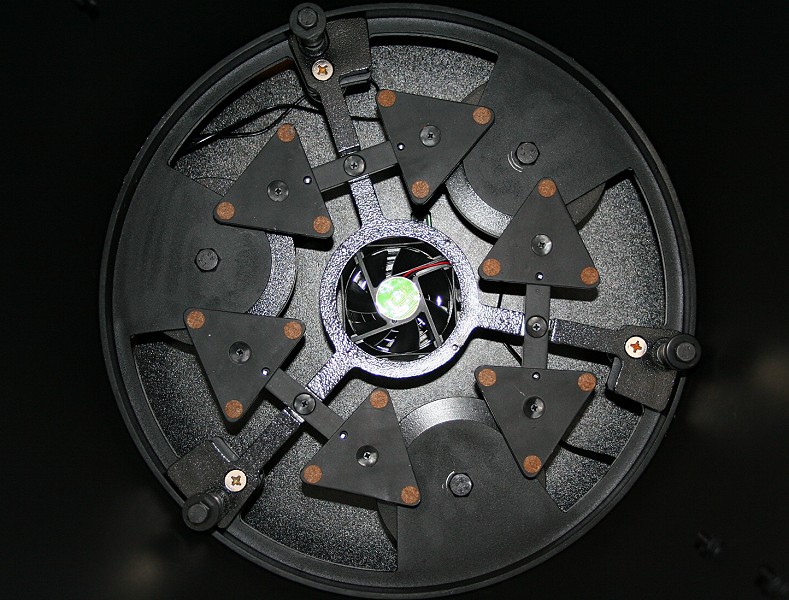
Here is an image of what the old mirror cell looked like on the XX14i from the article by David Knisely I linked above. This cell accepts the standard 2 inch (almost 2 inches) mirror that came with the first shipments and is open in the back (this looks to have a lid or to be sitting on a table). In this view you are looking down on the cell where the mirror would lay.


Here you can see a close up of the new mirror cell from behind and you can see the convex mirror sitting in the new cell. Click to enlarge or go to the Orion Telescope site to view it yourself here.


Here is an image of the bottom tube from the XX14g which seems to be the same now for the XX14i.


So be aware if your ordering an Orion XX14i or XX14g that you will be receiving a convex mirror with a different mirror cell. Glad I got one when they first came out as I am sold on what a Zambuto mirror can do in a scope. It might be a pain for Orion but I would love to see on the XX14i the option of mirror and cell you get but that won't happen since they are into mass produced scopes. I don't like the fact that Orion in some ways in doing this have limited options for those who purchase the scope in case they want to upgrade the mirror. It is never good for a product when choices are removed from the consumer. In my experience it usually means a short lifespan for the product but we'll see.

8/17/2011

For Local Observers or those wanting to travel Wolf Creek Pass August 26th and 27th

Well, a busy week at home and at work with another family member in the hospital this week. They will be released on Friday so that is good news. Anyway, this is for those local or for those who may want to travel but all are welcome!

On August 26th and 27th I and I am sure a group of others will be doing personal observing up at Wolf Creek Pass in the Uintah Mountains about 1.5 hours east of Salt Lake City. I will have the 14 inch scope there and IF your a newbie, not sure if you want to do this amateur astronomy thing or observing, IF you are willing and IF you leave me a comment here I will bring the 10 inch dob I own and I will teach you how to use the Telrad, finderscope, and a star atlas to find some pretty good objects in a Bortle 2 sky. Get there early so I can help you set the scope up and teach you some things in the daylight. If I don't get any replies then I'll simply leave the 10 inch at home. IF you know your coming and are experience but don't have a scope, I'll bring it and you can use it to look to your heart's content.

If you want to go but would prefer to follow someone, if you contact me I can probably arrange to have you meet me and then follow me up. I'll be leaving by 4:00p.m. to 4:30p.m. to get up there and set up before dusk.

Here are some posts about how to get up to Wolf Creek Pass at 9800 feet in elevation.

This link is to an older blog post from a year ago on the directions from the campground with pictures.

Here is a link to the written directions and I'll copy them here. They are from either the Salt Lake or from Utah Valley:

Wolf Creek Summit Star Party Travel Directions

DIRECTIONS FROM SLC

Take I-80 East (past Park City exit) to Exit 148. (Rt. 40 East). Stay to the right on the exit, as it splits. Head East on Rt. 40 to Exit 4. At the bottom of the exit ramp, go left towards Kamas. Follow this road as it winds through the hills to Kamas. In Kamas there is a stop sign at the intersection of this road and Rt. 32. Go right (South) on Rt. 32. Take Rt. 32 several miles to the intersection with Rt. 35 in Francis. See below for directions from Francis.

DIRECTIONS FROM UTAH COUNTY

Go up Provo Canyon either by going East on 8th North in Orem or by taking University Avenue North in Provo. Go past Deer Creek Reservoir and when you get to the stop light in Heber turn Left (North). Go all the way thru Heber. As you approach the Jordanelle Dam there will be a signal light. Turn right at the light and go several miles to Francis.

DIRECTIONS FROM Francis

When you get to Francis there will be a flashing light at the intersection. If you are coming from Provo, go straight (East). If you are coming from Kamas, turn left and go East. In about 3 1/2 miles you will go through a little community called Woodland. Continue on for another 16 miles (+ a little) to the summit of Wolf Creek Pass. You will see a sign for the Wolf Creek campground on your right. Go thru the campground on a dirt road. It is a little rutty at first. Continue on about 2 miles heading south, until you reach a "T" intersection. Turn Left and go past the "Dead End" sign .8 miles. There is a beautiful wide grassy area to the right.

Remember to dress WARMLY! We cannot emphasize this enough. Dress like you want to go night skiing and you might be comfortable. Hats, gloves, and warm boots are smart year-round. Keep in mind that you can always leave extra stuff in the car, but if you don't have enough layers, you'll be sorry!

Please use good star party etiquette; dim headlights if arriving after dark, and be sure to bring red lights for wandering between scopes, etc. so you don't spoil dark-adapted eyes.


Here is a link to a map in case your more visual.

Hope to see some of you up there!

8/14/2011

AstronomyLogs.com


I believe I have mentioned this website before and I believe I have it as a link, but I went to the site this morning and found it has been updated and new information added. So I thought I would review the site and the items there.

Here is a link to AstronomyLogs.com

The main page reviews what you can find in the site. One thing to know up front if your the type to just jump in if your reading in English, don't worry about the language tab. Everything is in English. If your not a native English speaker, pick your native language and the web pages are put into your native language. I believe the booklets though are still in English.

The booklets allow you to have a basic book for each of the objects. Similar to the logbook it allows you to fold the booklet in half to save space. The space isn't extensive, but allows you to enter the basic required information needed for yourself or to fulfill the AL requirements. Overall I really like the concise format found here. AstronomyLogs Booklets. Here is a view of the Messier Booklet:


The AstronomyLogs Log Books are one full page of the booklet that are regular size. The log book has a place for the Object, the date and time, site, see and transparency and the Equipment and then comments. The comments are a a full line so a little bit more than the booklet. I have used the H400 one and the Double Star one and I have gone into the space under the notes area. I tend to write a little larger and would prefer two lines if I am writing in the field. If I am transcribing from the digital recorder then I using the Word Format ones (they are the ones I use) since it is easy to type into the log. I'd like to see on for the AL Planetary Nebula program.

Here is the Herschel Log Book:


The DeepSky logs offer a variety of logs that one can use from simply information to ones with sketching from one item per page to two or five items per page. I really recommend looking over this page to see if one of these formats works for you. An excellent starting point for someone new to observing or looking for a way to record their observations.

The Reference Page is perhaps one of the handiest on the site. The first chart provides a way of rating the night sky. The next chart allows one to have a reference to the Pickering Scale for rating the quality of the night sky. The next three charts show rating limiting magnitude by the Little Dipper, Pegasus and Andromeda and Cygnus. The next one is the constellation names and abbreviations. Description Guidelines provides a way for someone who needs help in knowing what to write down or record by type of object (open cluster, planetary nebula, globular cluster, galaxies etc.). I really recommend that sheet for someone starting out or who hasn't recorded observations. You could cut out the descriptions, laminate on a 3x5 card and then have the card for when you observe. Dryer and Herschel Abbreviations, the Hertzsprung Russell Diagram, a Hubble Galaxy Classification, the Shapley Sawyer and Trumpler Systems are there as is an Averted Vision Scale that finish this section. Again, if your new to observing or looking for a place to print this off and have in one place this is a tab for you.

On the reference page a download table for the Antoniadi Scale needs to be included in my opinion (since I like using that one). Here is the sample of the page with some of the items.


Another jewel of this site is the findercharts. The finder charts are available for each program you want to go after and it has a wonderful planetary nebula. The finder charts are well drawn out, and very useful. Take a look and see what you look like.

Here is the finder chart for Messier 1:


The Lunar Atlas is equally useful as is the digital version that the site provides. Here I prefer my Sy&Telescope quick atlas but this one is more in depth and well done. A good reference to have on the computer.

Here is a sample of the Lunar Atlas.


I really recommend the H400 Atlas if you want a free atlas for hunting down the H400. The maps are there and if you can limit the light from a computer, is an excellent atlas to use. If not, and you spend the money to print off the atlas and put it in a binder in clear protective sheets it is still useful and one I recommend in using for the H400.

A sample from the Herschel 400 atlas:


The links tab shows some of the more helpful links that are available and some that are free atlases that go lower than the atlases provided here or in an outstanding lunar atlas.

So overall I really enjoy this site and recommend it. I would like to see a few more of the Astronomical League items on here. Check it out and see what you think.